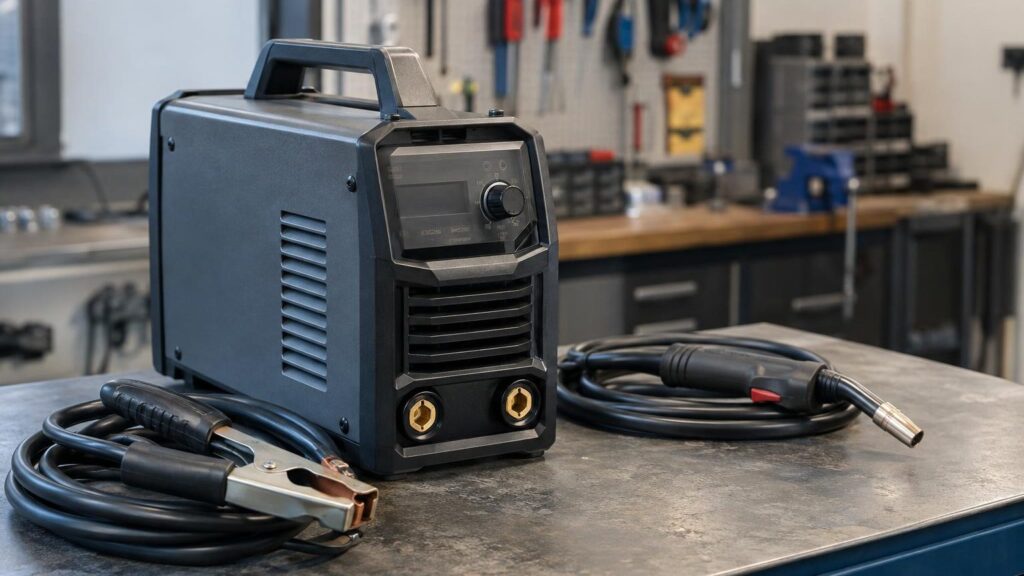
Bring it to the nearest branch or call
- VilniusKareivių g. 11A+370 655 77057
- KaunasSavanorių pr. 155+370 639 69600
- KlaipėdaSausio 15-osios g. 13+370 647 07741
- ŠiauliaiGegužių g. 30+370 682 29052
All branches are open Mon–Fri 9:00–18:00
Welding machine repair is needed when the machine does not turn on, cannot hold an arc, does not feed wire, or shuts off after a few minutes of work. This page will help you understand what most often fails, roughly how much a repair costs, and how the work is carried out at our branches – from diagnostics to warranty.
If you use the machine daily in a workshop or on construction sites, downtime is expensive, so below you will find specific symptoms, indicative prices and simple checks you can carry out yourself. We also repair other hand and power tools – see construction tool repair.
Welding machine repair prices
Indicative prices for the most common welding machine repairs.
| Service | Price | Warranty |
|---|---|---|
| Welding machine diagnostics | from €15 | – |
| Replacing the power cord, switch or knob | from €15 | Provided |
| Replacing or cleaning the cooling fan | from €20 | Provided |
| Repair of the torch, ground cable or electrode holder | from €20 | Provided |
| Repair of the semi-automatic welder’s wire feed mechanism | from €25 | Provided |
| Repair of the regulator, display or potentiometer | from €30 | Provided |
| Control board repair | from €40 | Provided |
| Inverter power module (transistors, diodes) repair | from 60 € | Provided |
Most common welding machine faults
Below are the symptoms with which machines are most often brought to us. If your case looks similar, first carry out safe external checks, and if that does not help, contact a branch. Do not open the casing: inside there are high-voltage capacitors that can be dangerous even when disconnected from the mains.
The welding machine does not turn on
The most common causes are a damaged power cord, a faulty switch, a blown fuse or the power section on the board. Sometimes the machine stops turning on after a voltage surge or use with a generator.
What you can check yourself: Try a different socket and extension cord, and inspect the cord and plug for kinks or burn marks. Check whether the circuit breaker at home has tripped.
We measure the power circuit and replace the cord, switch or damaged components. Replacing a power cord or switch – from 15 €, board repair – from 40 €.
The light comes on, but the machine does not weld
This is a classic electronics fault: the indicator shows that power is present, but the power section or control board is not working. A damaged ground cable or torch is also possible.
What you can check yourself: Check that the ground cable is properly connected and that the clamp touches clean metal. If you have another cable or torch, disconnect the machine from the mains, swap it and test with it.
We diagnose the power module and control section. Prices: diagnostics from 15 €, control board from 40 €, power module from 60 €.
The welding machine shuts off and shows overheating
The most common causes are blocked cooling, a fan that does not spin or a faulty temperature sensor. The duty cycle may also have been exceeded.
What you can check yourself: Wait 20–30 minutes for the machine to cool down and check that the ventilation openings are not blocked. Do not use the machine covered or pressed against a wall.
We clean the cooling system and replace the fan or sensor. Fan replacement or cleaning – from 20 €.
Semi-automatic welder does not feed wire
Most often the cause is worn feed rollers, a clogged liner or torch coil, or too much or too little tension. Sometimes the feed motor or its control fails.
What you can check yourself: Check that the roller groove matches the wire diameter, that the tip is not clogged and that the wire is not tangled on the spool.
We repair or replace feed mechanism parts and clean the torch channel. Work from €25.
Wire sticks or the electrode sticks to the metal
This happens due to poor contact with the ground, too low a current, a worn tip or an unstable power section. In stick welders, a common cause is damp electrodes.
What you can check yourself: Clean the metal where the ground clamp is attached, increase the current according to the electrode or wire diameter, and try dry electrodes or a new tip.
If everything is in order, we check the machine’s output parameters and power section. Diagnostics from €15.
Unstable arc, a lot of spatter
The usual culprits are poor-quality gas, too low a gas flow rate, a worn torch part or a cable contact. Sometimes the problem is caused by a fault in the control electronics.
What you can check yourself: Check the gas pressure and the tightness of the hoses, replace the tip, and make sure the wire and electrodes are suitable.
We check the torch, cables and control circuit. Torch or cable repair from €20, regulators from €30.
The machine trips the fuses
There may be a short circuit in the power section, damaged transistors or diodes, or moisture inside the housing. Also, not all household electrical networks can handle a higher-power machine.
What you can check yourself: If the fuse trips immediately when you switch on the machine, turn it off, unplug it and do not try again – contact a technician.
We diagnose the power circuit and replace damaged components. Power module repair from €60.
The regulator or display does not work
A worn potentiometer, a loose contact, a damaged display ribbon cable or a control board fault. Dust and moisture also affect the control elements.
What you can check yourself: Check that the settings have not changed due to an accidental button press – some models have a lock or reset function described in the manual.
We replace the regulator, renew contacts and repair the board. Regulator repair from €30.
TIG welder does not strike an arc
The gas valve, the high-frequency ignition unit may be faulty, or the torch may be damaged or the ground contact poor. Some problems are also caused by improperly prepared tungsten.
What you can check yourself: Check that the gas cylinder is open, that the tungsten tip is properly sharpened and that the torch is sealed.
We check the ignition unit, the valve and the torch. Repair usually costs from €25 to €60, depending on the fault.
The machine hums, smells of burning or chokes
This is a sign of overload, a burnt-out component or an electrical contact fault. Using such a machine is dangerous.
What you can check yourself: Switch it off immediately and unplug it from the socket. Do not try to switch the machine on again and do not open the housing.
During diagnostics we will identify the damaged parts and quote the repair price. Diagnostics from €15.
Damaged torch, ground cable or electrode holder
Due to constant bending, the cable wires break, the tip overheats and the holder melts. Sometimes the machine seems faulty although the problem is only in the accessory.
What you can check yourself: With the machine disconnected from the mains, inspect the outside of the cable and the connectors for broken strands or burn marks. Do not use a damaged cable.
We replace cables and connectors and repair the torch. Work from €20.
Welding machine repair: is it worth repairing or buying a new one?
The decision depends on the machine’s class and the fault. For a cheaper household inverter, whose new price is around €100–150, it would make no sense to pay €80 or more for a repair if the main power section has failed. On the other hand, a semi-automatic or TIG welder costing several hundred euros is usually worth restoring – the fault is often small and inexpensive.
A simple rule of thumb: if the repair cost does not exceed one third to one half of the price of a comparable new machine, repair usually pays off. The age and the availability of spare parts for the specific model should also be taken into account.
During diagnostics, the technician identifies the fault and quotes the price, and the decision is yours. If the repair turns out not to be worthwhile, we will tell you right away.
- Worth repairing: a faulty switch, cable, fan, wire feed mechanism, regulator or a disconnected contact.
- Worth calculating carefully: a burnt-out power module or control board in an inexpensive machine.
- Usually not worthwhile: a machine after flooding or a heavily oxidized board with several damaged components.
Bring the machine together with the torch, ground cable and power cord – this makes it easier to tell whether the fault is in the machine itself or in the accessories.
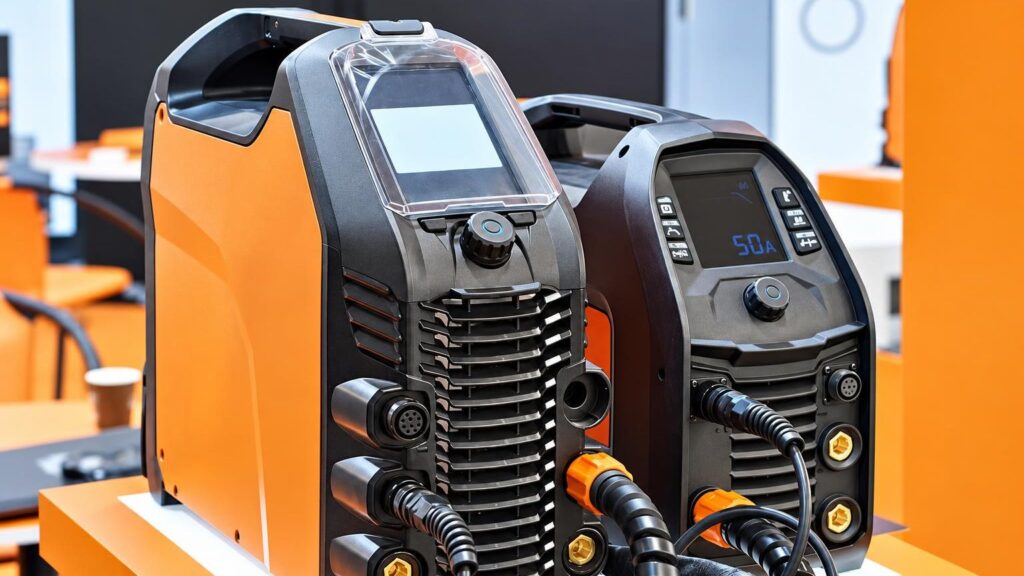
Which manufacturers’ welding machines we repair
We repair welding machines of all types and manufacturers. We receive a very wide range of models: Kempas, Jasic, Telwin, Awelco, Lincoln Electric, Fronius, Depo, Ermitazas and many lesser-known imported brands.
We are not an official service center of any manufacturer – this is independent repair, where the main thing is that the model’s electronic circuit can be fixed and the parts can be found.
If the machine still has a manufacturer’s or seller’s warranty, first read its terms: independent repair may void it.
- MIG/MAG semi-automatic welders (with wire feed and gas or flux-cored wire)
- TIG machines, including AC/DC models
- MMA (stick) inverters and older transformer-based machines
- Plasma cutting machines and battery charger-starters – where possible, after diagnostics
How to extend the service life of a welding machine
Most faults are caused by dust, moisture and overload. In a workshop, the heat sinks inside an inverter quickly become clogged with metal dust, the fan starts picking up debris, cooling weakens and the electronics overheat.
A properly maintained machine works for many years. A few habits that cost nothing are enough.
The machine should be kept in a dry place, not directly on the ground, where water may seep in or metal shavings may fall onto it.
- Observe the duty cycle (ED %) indicated on the rating plate – after intensive work, let the machine cool down while the fan is still running.
- At least once every few months, with intensive use, clean the cooling system of accumulated dust – this is done by a technician, not by the owner opening the casing.
- Use a good-quality extension cord with a sufficient wire cross-section and avoid weak generators – voltage surges damage inverters.
- Do not twist the cables into sharp loops and do not pull the torch off the wire feed mechanism by force.
- Regularly replace the torch tips, nozzles and wire liner – a worn part overloads the feed mechanism.
If you know that you work in a dusty environment, bring the machine in for preventive cleaning at least once a year – it is cheaper than repairing an overheated board.
What to bring and how to prepare for your visit
Bring along with the machine all the accessories involved in the fault: the power cord, earth cable, electrode holder or torch. Briefly tell us when the fault appeared, whether the sound or smell changed, and whether the machine tripped the fuse.
If you need a report for insurance, mention it in advance – we issue reports for insurance. Our branches operate in Vilnius, Kaunas, Klaipėda and Šiauliai, open Mon–Fri 9:00–18:00, closed on weekends. You will find addresses and contacts on the contacts page.
How welding machine repair works
- Visit a branch. Bring the machine to a branch in Vilnius, Kaunas, Klaipėda or Šiauliai, Mon–Fri 9:00–18:00. Bring the torch, cables and power cord.
- Describe the fault. Briefly tell us what happened: it does not turn on, it switches off, it does not weld. This helps find the cause faster.
- Diagnostics. The technician inspects the machine, identifies the fault and tells you the preliminary repair price and turnaround time.
- We agree on the price. Repair begins only with your consent. If repair is not worthwhile, we will tell you so.
- Repair. We replace or repair the damaged parts and test the machine under operating conditions.
- Pickup and warranty. You collect the repaired machine, receive a warranty for the work performed and, if needed, a report for insurance.
Frequently asked questions about welding machine repair
How much does welding machine repair cost?
Diagnostics start from 15 €, replacing a cable or switch – from 15 €, replacing or cleaning a fan – from 20 €. Repairing power modules or boards is more expensive. We give the exact price after diagnostics and agree on it with you before starting the repair.
Where can I get a welding machine repaired in Vilnius, Kaunas, Klaipėda or Šiauliai?
You can drop off the machine at a Taisykla7 branch in any of these four cities. You will find addresses and opening hours on the contacts page.
Do you have branches in Alytus, Panevėžys or Utena?
No, we have branches only in Vilnius, Kaunas, Klaipėda and Šiauliai.
Do you provide a warranty for welding machine repair?
Yes, a warranty is provided for the repair work performed. Please confirm its specific duration and terms at the branch before handing in the machine.
Can you issue a report for insurance?
Yes, we issue reports for insurance. If you need a report, tell us when you hand in the machine.
Do you repair welding machines of all manufacturers?
Yes, we repair welding machines of all types and manufacturers. If the machine still has a seller’s or manufacturer’s warranty, first find out its terms.
How long does a repair take?
It depends on the fault and on whether the part is in stock. Simple faults are identified during diagnostics, and we will tell you the turnaround time right after it.
How can I find out whether the repair will not exceed the value of the device?
After diagnostics, you will receive a description of the fault and a price. If the repair would cost too much, you can decline – the choice is yours.